By Rasaalika Singhania
When I first arrived at Scuba Seekers, I was thrilled to find that the dive centre offered weekly cleanup dives at Mashraba, Scuba Seekers’ house reef. Week-on-week, Christina Ewerhardy, Karim Nagui, and later, Pauline Grosclaude, would diligently donate their time and energy to leading free dives for any divers wishing to help mitigate some of the impact us humans have on the ocean that has given many of us so much. Sometimes they’d be joined by just one or two divers, and sometimes, many, many more; they would brief divers on how to ensure they weren’t causing any harm (and therefore how to ensure correct buoyancy and positioning in the water), how to protect themselves from injury and to ensure they didn’t accidentally collect live marine life, and ultimately, how to achieve the goals of such dives in a safe, team-oriented manner.
During my life before Scuba Seekers, I used every dive to collect any litter I found in our precious ocean, often exiting the water with stuffed pockets; but I received mixed reactions. Often, other divers would follow suit, which gave me hope, but other times I was told off for not focussing on the marine life and for collecting trash and untangling fishing line instead. Never had I come across an operation that did these things offline, off social media, and regardless of how many people joined them, with social media followings big, small, or non-existent. What the Scuba Seekers team did was the opposite of performative. It was a genuine, consistent, and dedicated effort to try to mitigate the impact our species has on the life force of the planet – the ocean.
It was around this time, or approximately two years ago, that our Head of Conservation, Christina Ewerhardy, shared with many of us that a huge amount of plastic debris had been reported in the waters of Lagoona Beach. Thus began our Lagoona mission.
During our first cleanup dive in the waters of Lagoona, we were shocked and heartbroken: layers upon layers of plastic waste choking a once pristine ecosystem. Tens of thousands of plastic cups, plastic bags, cutlery, straws, drink bottles, plastic labels, and hundreds of meters of discarded fishing line, hooks, and weights, all sitting barely 10 meters below the surface, along a 2.1km shoreline, where seagrass, corals, and precious marine life fought to thrive despite the immense human burden destroying their home.
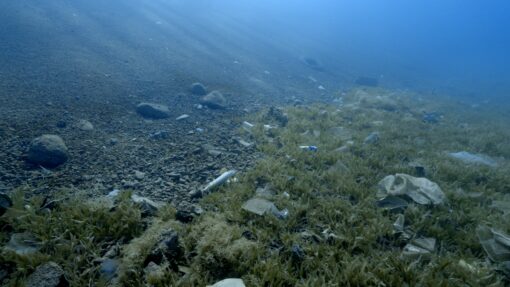
On the surface are resorts, and a public tourist beach. Trash enters the water in two ways. Firstly, through irresponsible tourism with people armed with food and drinks to sustain them through their days discarding huge amounts of plastic at the water’s edge, that are carelessly left to fly in or at worst, intentionally throwing their rubbish into the water. The second is the prevailing wind. Lagoona beach is well-known for its windy conditions; trash from bins, and trash left on land, slowly but surely finds its way into the water.
What’s striking is that despite having almost eliminated trash from parts of the underwater coastline, months later after a busy tourist season, the situation has reverted. This suggests that most of this trash is coming in through irresponsible visitors, with the biggest culprit being discarded single-use plastic cups.
What have we done about it in 2025?
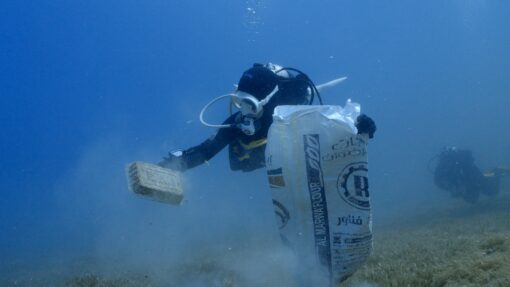
At our house reef, we have run 50 cleanups, meaning we have done our weekly cleanup every week of the year except two. On these cleanups, smaller items are common, likely flying in from the cafes and restaurants that line Mashraba and Lighthouse, or the main promenade of Dahab. Each dive here yields hundreds of cigarette butts, degraded plastic fragments from what were once drink labels and plastic bags, and the occasional floor pillow or astroturf that has been blown into the bay on a particularly windy day. On these dives, we have collected approximately 355kg of trash, collectively. While this may not sound like much, smaller items yield less weight, but they are just as harmful to the residents of these waters. Hawksbill and green turtles, various species of rays, and endemic reef fish, all of whom cannot discern the difference between plastic waste and their food are consuming degraded microplastics as a result of anthropogenic impact.
At Lagoona, we conducted 8 cleanup dives during the year resulting in the collection and removal of 587kg of marine litter. The last three of these cleanups were conducted in collaboration with Healthy Seas, a foundation committed to removing marine litter, especially fishing nets, to foster healthier seas and repurpose waste into innovative products, who work with innovative partners, businesses, and global collaborators to create cleaner, more vibrant marine ecosystems, and fight to ensure our oceans remain a safe haven for marine life and a source of beauty and inspiration for future generations.
How do we conduct these dives?
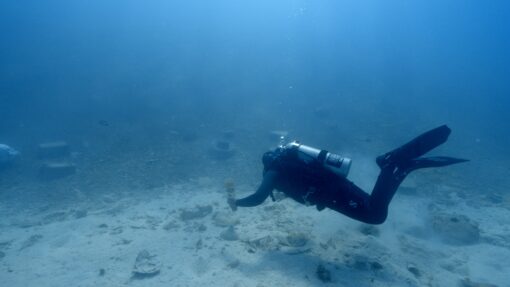
Given the workload, surface conditions, and surface activity at Lagoona, we have one safety diver for every five volunteers. Divers are required to strictly adhere to briefings, and stay within the safety divers line of sight. Only designated and experienced divers are permitted to collect fishing line, with fishing line often stretching tens of meters away from the group with significant risk of being separated from the group.
The way forward
The task at hand under the surface at Lagoona is daunting indeed. Despite our consistent efforts, we have barely scratched the surface, and only covered perhaps 100 meters of the 2.1km stretch that makes up Lagoona. Mashraba too requires consistent stewardship to maintain the treasures it reveals every season.
We started this year on a sombre note that was punctuated by inter-disciplinary teamwork – in January, we got together with a team of freedivers to remove a devastating net from the waters of Lagoona – this net claimed the lives of a juvenile reef shark and a juvenile manta ray, that had been predated by a larger animal in its fight to survive its entanglement in this net. We rarely, if ever, see mantas or sharks of any kind in Dahab. It was gut-wrenching to see juveniles that never had the opportunity to reach adulthood or produce offspring fall victim to discarded fishing gear that continued to kill long after it was abandoned. With 11 cleanups of Lagoona’s waters planned for 2026, and another ghost net already scoped and removal planned, we have our work cut out for us.
What can you do to help?
Sometimes, I hear divers speaking as if it is not their responsibility to participate in cleanup dives anywhere. Divers that simply utilise the ocean for various reasons, but do nothing to give back. As an underwater camerawoman, I understand that recovering human generated trash isn’t “sexy” diving – it isn’t visually beautiful, doesn’t garner social media likes, and most of all, forces each and every participating diver to confront one’s own consumption habits, and gives each one a new lens through which to view what they buy, what they consume, and how they live.
As a result, our cadre of cleanup divers keep coming back. We not only collect and remove trash, we sort and examine it for remaining life, freeing even the smallest of crustaceans back into the ocean, and weigh it, as some small measurement of our impact. Whilst the impact numbers are daunting, the enthusiasm and commitment of this small group of divers gives us hope.
In 2026, we continue to work relentlessly to preserve the oceans so that all that enjoy, utilise, or depend on it can continue to do so, and we encourage you to sign up to initiatives in your area, and join us whenever you visit Dahab. We also endeavour to make these opportunities more accessible this year and will be utilising social media for this purpose, as well as to create increased awareness and participation. While your and our efforts may just be drops in the ocean, it is through such drops that an ocean is made. Be a steward of these oceans that have given us all so much and do your part.
We will be launching a marine life, ecology, and conservation channel over social media for divers to participate in citizen science, conservation initiatives, and ecology courses. Stay tuned to our social media for updates on this front – we look forward to diving with you.

Rasaalika spent over thirteen years in strategy, investment banking, and asset management for the impact investing sector prior to her first dive in the low-visibility waters of Singapore. Like many others, she was captivated by every aspect of the ocean and all its wonders. She gave up corporate life and dove into the ocean full-time, diving across nine countries—with the sharks of the Maldives and in the frigid waters of Lake Huron—before landing in Dahab and falling in love with technical and CCR diving. She is now a key member of Scuba Seekers’ marketing team, Program Manager for Scuba Seekers x Healthy Seas, and Scuba Seekers’ resident underwater camerawoman, and is a rEvo Hypoxic Trimix 100m diver with over 350 hours of rebreather experience.
You can follow her adventures on www.rasaalika.com or instagram: @ras.underwater